In recent times I have become a little more active on Social Media once again, not something that hugely appeals to me if I am honest, but these days if you want to be found amongst the sea of blogs, social posts, videos and more; then getting a handle on social media is the best way to make those connections with those wishing to read my content. If I am honest my 15 year daughter could probably manage my social media better than me and complete what I manage to do in less than half the time. However, I have never been one to shy away from these challenges and as such I find myself at sea in a raft when it comes to making social media work for me a little. It was whilst engaging with the likes of Facebook, Instagram or X (I miss Twitter, just saying); that I stumbled on a few stories regarding something I had looked into previously – the Estes Method. This approach to ghost hunting has been popularised by TV shows and fellow hunters of spooks out there greatly, but I guess I was quite surprised to have it pop up on social media, as I thought the hype may have faded away by now.
However, it appears that the Estes Method has become known to be one of the more focused or more controlled approaches in comparison to standard spirit box sessions, which also may be why this method has gained the popularity that it has. I have to wonder as a paranormal investigator and researcher; if it is genuinely useful as an investigative technique, or is it simply a modern reworking of older EVP-style ideas packaged in a more dramatic way?
Don’t get me wrong I have tried the technique; and this post is not about mocking it or even blindly endorsing it, but more about having a look at its origins, its appeal, and how it is treated within the paranormal community.
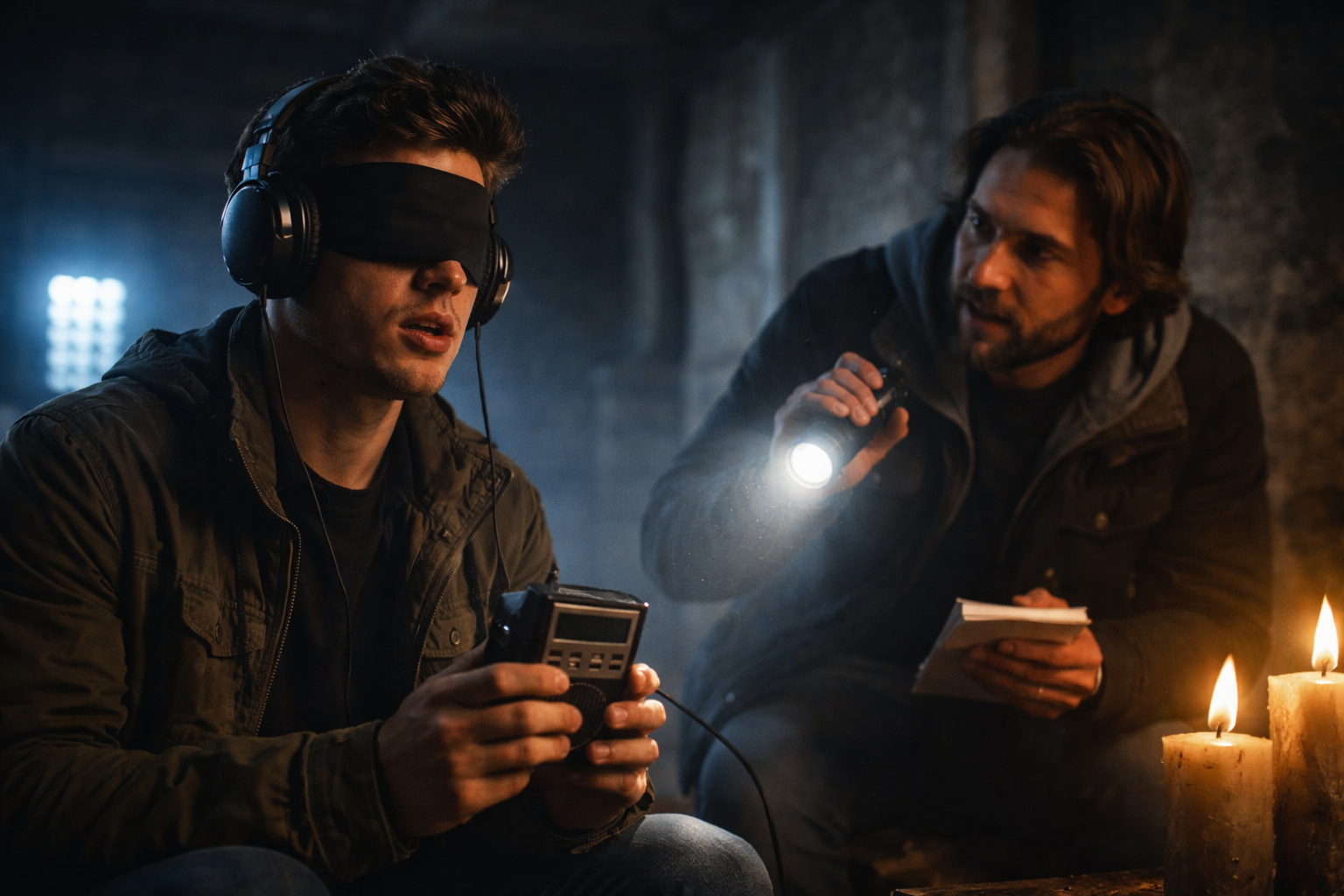
As I don’t have the time to delve too deeply here, let me provide a brief overview of the method. One person listens to a spirit box through headphones, often blindfolded, while another asks questions and listens for apparent responses. The individual listening is often described as being isolated from everyone else; placing focus on their responses based on what they are hearing from the spirit box. This is to provide the impression that they are not likely to be influenced by others present, meaning they have no idea what the questions are that are being asked out loud to the environment.
And that is pretty much it; one person isolated visually and audibly from the rest of the group; and only receiving information in the form of audio from a spirit box (a simple radio skipping through the stations). As they hear words through their headphones, they will say them out loud to the room. All the while the other person asks a series of questions, either predetermined or naturally moulded based on the response to the previous question, to provide an appearance of conversation.
I suppose the element of actively listening and providing information that may be interpreted as being answers to the questions being asked, which in turn may suggest the illusion of a conversation; would likely be quite appealing to ghost hunters. Especially when you consider that this feels as if it is happening in that moment. It can provide that belief of being able to communicate with spirits.
The origins story of the Estes Method generally takes you back to 2016 and the Stanley Hotel in Estes Park, Colorado; where Karl Pfeiffer, Connor Randall and Michelle Tate use it and the name is said to come from Estes Park itself. However, the sources for this come in most part if not all from the online creator community rather than a formal academic record. And even though this origin story seems to be pretty consistent across many paranormal sources, we always should be cautionary of such things.

However, I would also have to point out that whilst this method may only be relatively recent, the ideas behind are not. Even though the Estes Method has grown in popularity, this approach has not appeared out of nowhere. Its roots can be found firmly within the broader history of Electronic Voice Phenomena (EVP) and Instrumental Transcommunication (ITC) practices. Classical EVP is generally linked to Friedrich Jürgenson in 1959, which was later popularised by Konstantin Raudive. As technology progressed forward so did the techniques used, moving towards real-time communication devices, especially around the ghost boxes and radio frequency sweeping methods. So, the Estes Method fits more naturally into this later spirit-box branch than into the classic tape-based EVP methods. Making the Estes Method a direct descendant or evolution of EVP.
So, why is the technique so appealing to the modern ghost hunters out there then? The method itself feels immersive, dramatic, and somewhat interactive. The question and answer approach provides the sense of direct spirit communication rather than process of passive observation. Equally the setup presents a controlled approach that gives the sense of something scientific rather than the chaotic group spirit box sessions previously experienced; which is driven home through the isolation of a single person cut off from the rest audibly and visually. This in itself may be partially why it has become such a strong feature within the ghost hunting community. And such approaches generate experiences and as many are seeking an experience of some kind their belief in the method is strengthened.
Unfortunately, based on what I have found three does not appear to be a strong body of peer-reviewed research directly testing the Estes Method itself. The method does appear in the academic literature for sure, but mainly as a part of a discussion about paranormal culture, ghost hunting media, ritual, and meaning-making. I have not been able to locate it to be presented as a scientifically validated method. The method as such is widely discussed, don’t get me wrong, but only as a contemporary practice and certainly not robustly tested as an evidence-gathering tool. From what I can understand; most peer-reviewed papers seem more interested in what the Estes Method reveals about the paranormal culture rather than proving whether or not it actually works.
The Estes Method does present some very obvious strengths and limitations;
Potential strengths:
- Structured setup
- Reduction of obvious visual and social cues
- Can produce some interesting material
Limitations:
- Vulnerable to suggestion and retrospective interpretation
- “hits” can stand out while irrelevant responses are forgotten
- Question wording can steer meaning
- Dramatic atmosphere may make weak connections feel stronger than they really are
To be clear, I am not stating that this method is worthless; I am simply stating that its value is hugely dependant on how cautiously it may be used and interpreted.
The Estes Method is certainly culturally important in our modern ghost hunting community; with its clear connections to older EVP-style traditions, it can be well placed as a new evolution of the EVP and ITC approaches. However, at present, it would seem to better understood as a compelling contemporary technique rather than a well-validated investigative method. It equally has that conceptual appearance of something that is desired to be similar to a laboratory experiment utilised in the field; something which I have also seen and attempted in relation to the Ganzfield Experiment.
This does not mean that we should dismiss the Estes Method outright though, just that if our intention is to perform valid investigation of a case; then we should be approaching this method, and others like it, with more caution than the hype often seems to allow.
The Estes Method is best viewed as a modern spirit-box technique with its roots firmly situated in the older EVP traditions. Whilst it is very intriguing, popular, and worth discussion; it is yet to receive strong support through direct academic testing.

 Ashley Knibb