
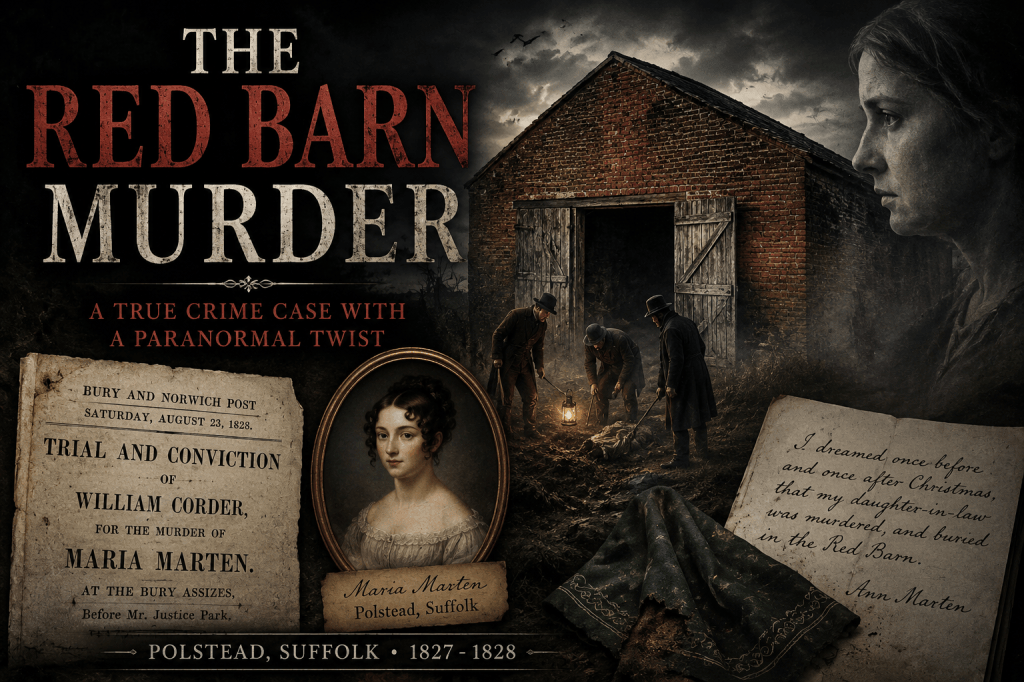
For this blog post I wanted to bring you something a little different. Now looking at some true crime cases that appear to have a paranormal connection, is something I have certainly done before and it does leave you wondering about the concept of whether we do survive after death or not. Especially when some of these restless spirits manage to find ways to communicate key information related to their own deaths back to the living. So, when a young lady goes missing from Polstead in Suffolk back in May 1827, her parents become suspicious. A suspicion that grows when her boyfriend sends letters stating shes moved away but is absolutely fine. However, when her step-mother has frightening dreams of what actually happened to the young lady and where her body may be buried, what follows is hard to believe.
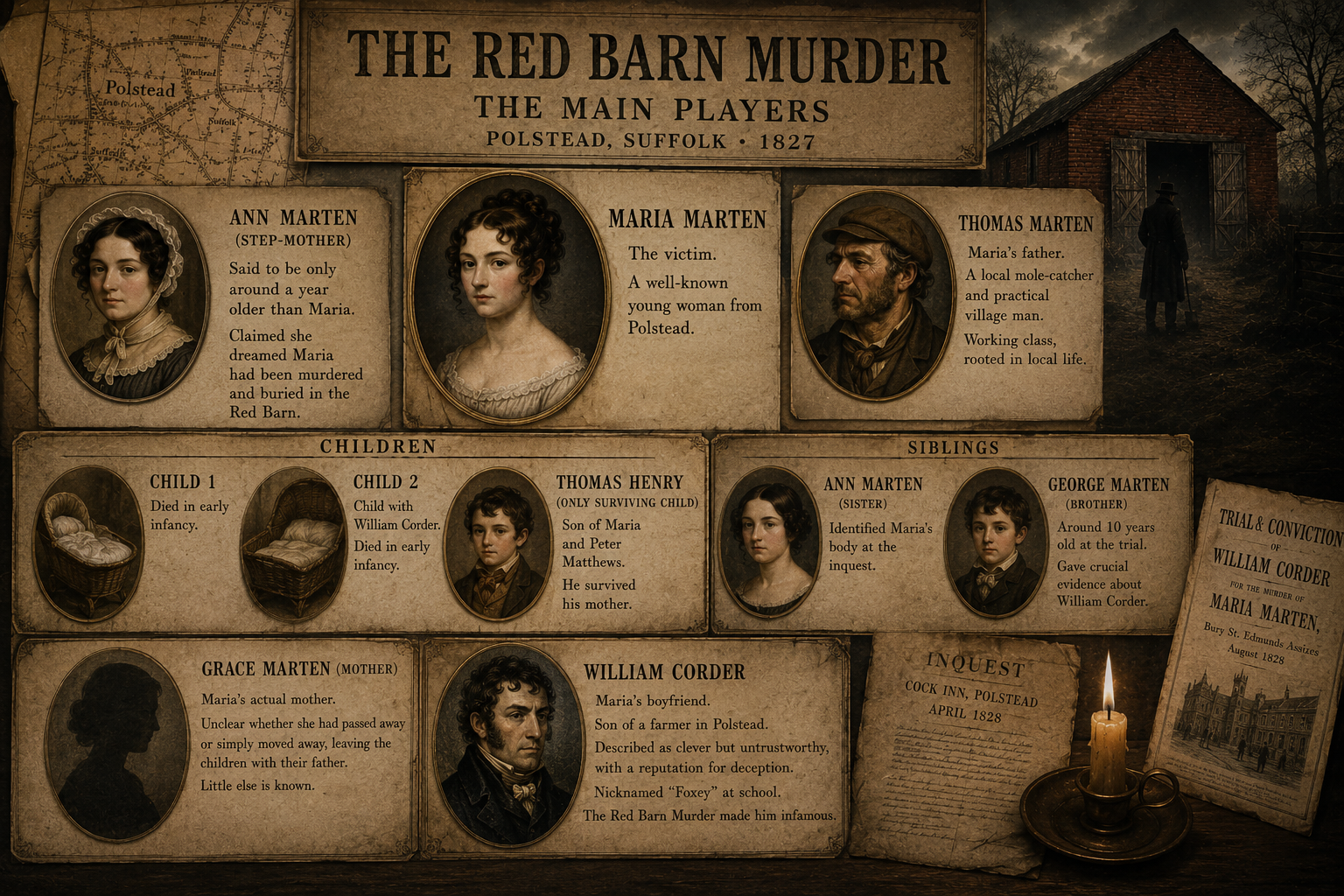
Maria Marten was a young woman from Polstead in Suffolk, the daughter of Thomas Marten, a local mole-catcher. She was often presented as being attractive and also well known in the village, but also as being quite vulnerable to gossip because of her relationships and children outside of marriage. Something that would have not gone unnoticed by the local residents in such a small rural community. Within the Red Barn Case, she does not only stand at the centre as the victim, but equally as someone who had her entire private life turned into a public spectacle.
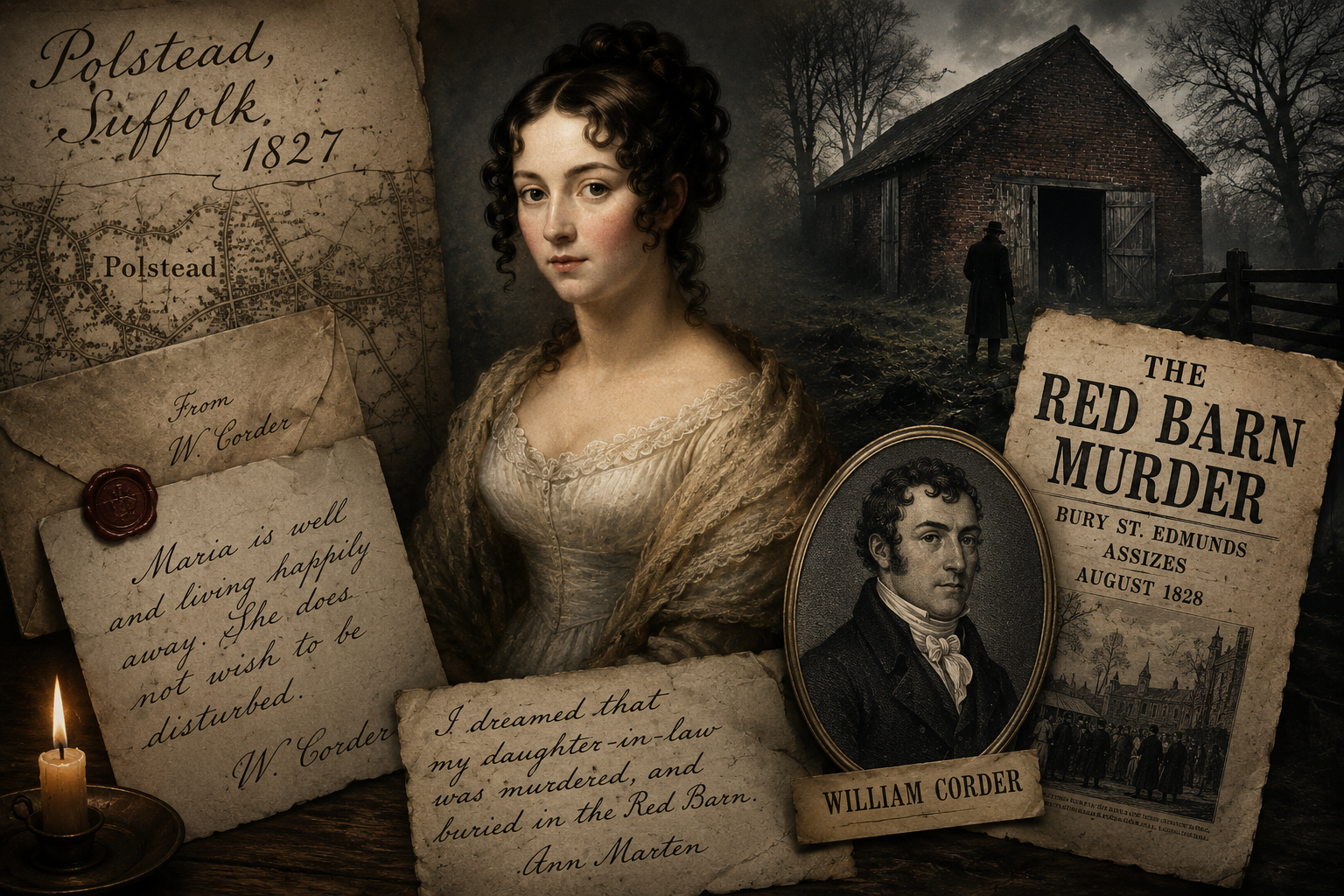
Maria had three children, but during the early 1800’s in rural England things were not always straight forward and certainly not easy. One of her children died in early infancy as was often the case. The child that she had with William Corder also passed away during the early part of its life. This meant that her son Thomas Henry, who she had with Peter Matthews, would be the only child to survive her. This on its own adds to this deeply sad story, but was equally not uncommon at the time.
Thomas Marten, Maria’s father, was a local mole-catcher; making him very much within the working rural world of the nineteenth century in Suffolk. He was certainly not a member of the farming elite, which immediately provides us some insight into which class he may have been a part of and as such which class Maria would have also aligned with during the time. Thomas comes across as a practical village man during this case, very much rooted in local life, but was drawn into a national sensation through the disappearance and death of his daughter.
Ann Marten was Maria’s step-mother and was said to only be around a year older than her, which has made her one of the more intriguing figures in the story. What is clearly documented is her place in the household and her later claim that she dreamed Maria had been murdered and buried in the Red Barn. Beyond that, we know little more about her, which is odd considering how important she is to this story.
Maria also had siblings, a sister called Ann and a younger brother called George. Her sister Ann later identified Maria’s body during the inquest; which must have been a horrifying task. At the time of the trial, George was said to be around ten years old, but gave crucial evidence about William Corder.
Maria’s actual mother, in case you were wondering, was called Grace, but its unclear if she had passed away or just simply moved away leaving her children with their father. I wonder if there is more to that story that we know currently.
That leaves William Corder, who came from a more prosperous local background than Maria; he was the son of a farmer in Polstead. Some contemporary and later accounts often describe him as being clever, but also untrustworthy. He also had a reputation for deception and petty fraud on occasion. He was also said to have the nickname “Foxey” at school for his sly manner. In regards to the local community though, he was seen to be more aligned with an outsider, but also as a local man that was known for possessing a bad character, which was often remarked on. The Red Barn Murder made him infamous.
These should be considered the main players in this rather unusual case and it was certainly a case that if it was not for Maria’s step-mother may have been just another murder. However, that was not to be the case and the events that unfolded were quite remarkable. So, lets take a little look at the timeline shall we.
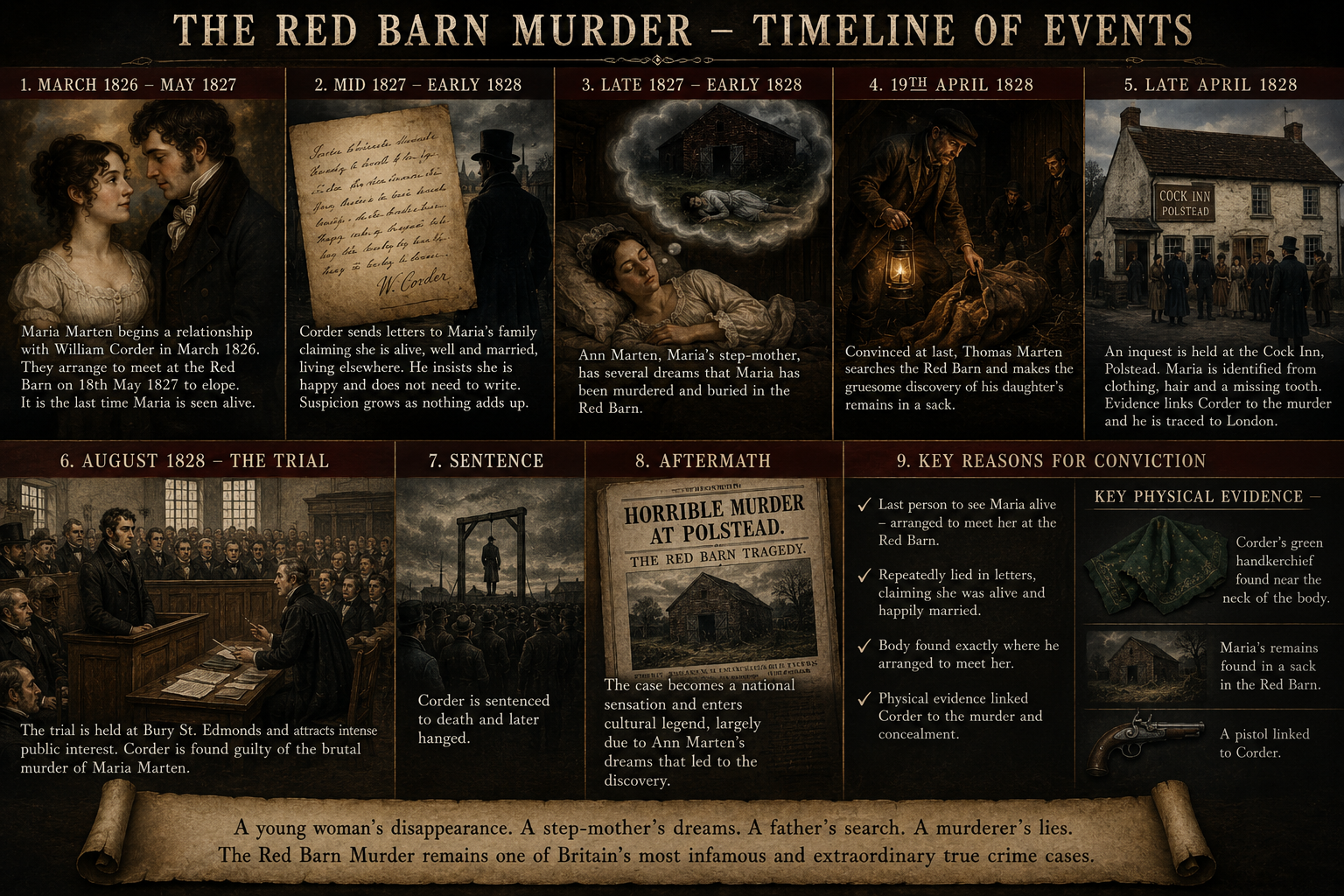
In the March of 1826, Maria begins a new relationship with William Corder. Both of them are well known to the local community, and their relationship continues through to May 1827. However, on the 18th May 1827, Maria leaves to meet Corder at the Red Barn. Supposedly the pair have decided to get married and have arranged to meet before they elope. This will also be the last time that Maria is seen alive.
Around the middle of 1827 through to the early months of 1828; Corder sends a few letters to Maria’s family, claiming that she is alive and well, married and the pair are living elsewhere together. However, suspicion begins to grow within the Marten family as they have heard nothing from Maria directly, somethings they are told are just not adding up.
Ann Marten, Maria’s step-mother, has several dreams about Maria. These are believed to have occurred during late 1827 into the early parts of 1828. The dreams Ann has tell her that Maria is certainly not okay and that she has been murdered, but following that murder she was buried in the Red Barn. Now, it must have taken some time to convince Maria’s father that these dreams actually meant something, because it was not until the 19th of April in 1828, that Thomas searches the Red Barn. It is during this search that he makes the gruesome discovery of his daughters remains in sack. This part alone of the story is where I think it goes from strange to ridiculously strange. Having your daughter missing and suspect foul play is one thing, but to have those suspicions realised by a dream elevates that weirdness certainly. However, based on all that, to then discover and dig up your daughters remains; well its just something that no father should have to go through.
Later that April, an inquest is held at the Cock Inn in Polstead, which is still there today. Maria is identified from the clothing found with the remains, but also from hair and physical features, such as a missing tooth. Evidence is later found to link Corder to the murder and he is traced to London.
During August of 1828, the trial for the murder of Maria takes place at Bury St. Edmonds, which has intense public interest. Corder is found guilty and later hanged for the brutal murder of Maria Marten. Following this the reports of the murder and the case in general grow to a cultural legend because of the dream of Ann that helped to discover the body.
Just to clarify, Corder was found guilty because he was known to be the last person to see Maria alive. Then he lied repeatedly about where Maria was, trying to convince here family that she was happily married and did not need to communicate or see them. This pattern of deception added to the case against Corder. Maria’s body was also found exactly where Corder arranged to meet her, which was seen as suspect; perhaps he had arranged to meet her there with the intention of killing her all along. There was physical evidence found with the body that directly linked to Corder, which also linked to the murder and concealment. This included Corder’s green handkerchief, which was found near the neck of the body.
Corder claimed that he left Maria alive in the Red Barn after an argument, but then returned when he heard a gunshot, only to find her dead. The cause of death at the trial was not exactly certain, as the body was very badly decomposed. Whether she was shot or not, was never clearly proved.
Corder’s conviction was said to come after only thirty-five minutes of Jury discussion. Following his conviction, Corder was said to confess that he had shot Maria after an argument.
Whilst Maria’s murder was brutal, and the circumstances around this case certainly strange; we should also look at the more supernatural aspects here. It could be said that if Ann did not dream of Maria’s murder and the location of it, then perhaps Thomas may never had discovered her body and Corder with have got away with murder. Is this entirely true though?
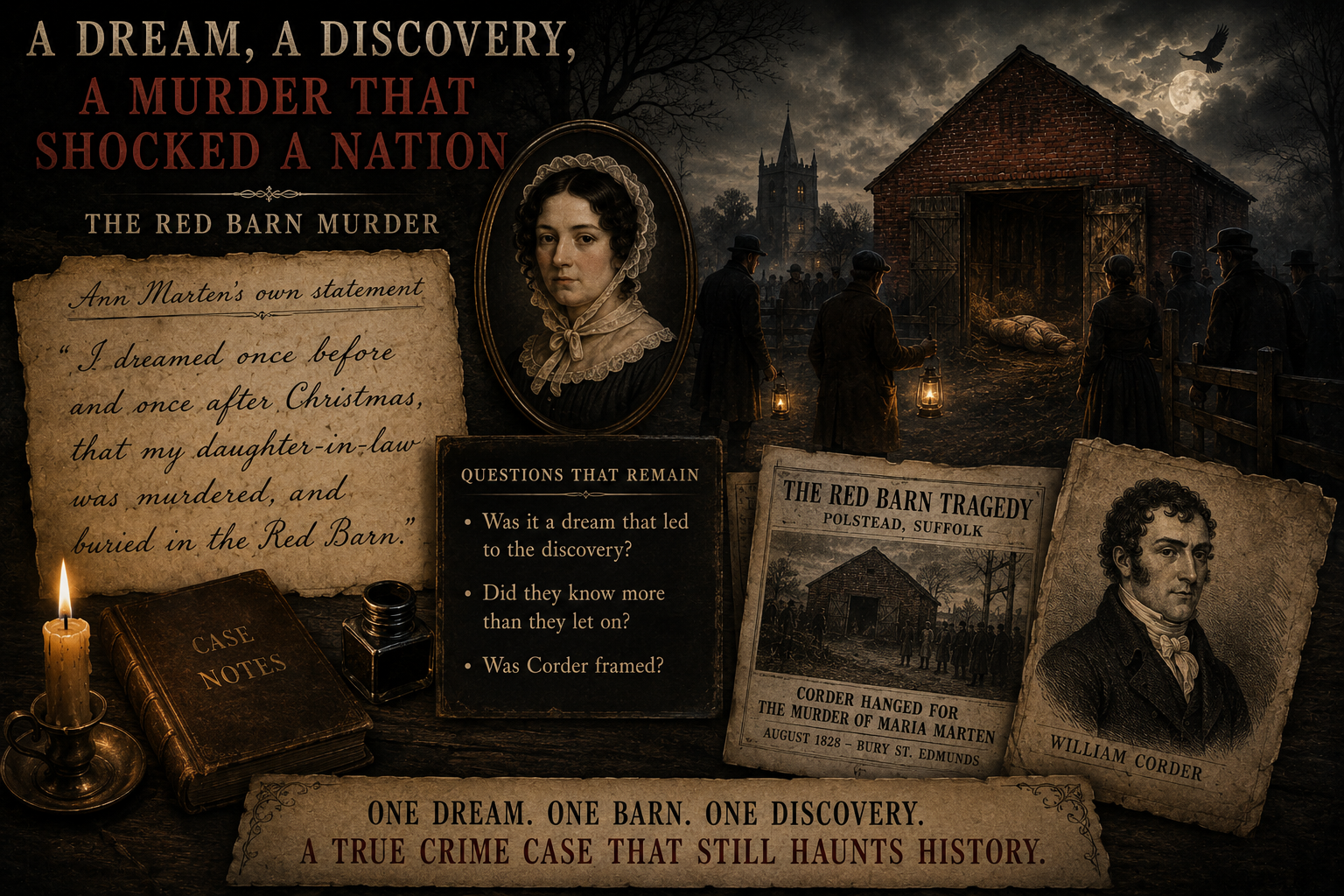
Certainly we know from Ann’s own statement regarding the dream; “I dreamed once before and once after Christmas, that my daughter-in-law was murdered, and buried in the Red Barn.” That she dreamed twice around Christmas time. Which meant this was not what would be called a crisis apparition type event, although perhaps we should not restrict the timings of these to simply being around the time of death. Perhaps it was an After Death Communication (ADC); but that said Ann never describes the dreams as being something that contained communication with Maria. They probably fit more into the realms of some kind of retrocognitive dream, where Ann was seeing events that had already occurred.
That said, we also have to look at the reality of the events here too. Maria was last seen in May 1827, the family had no contact with from that point; and Ann did not dream of her until around Christmas time. A time of the year that is very much linked to family coming together in some cases. Is it possible that, missing Maria, knowing that she was last seen at the Red Barn; that young George had seen Corder with a gun and axe near there too; simply meant that they came to the right conclusions in their mind. Thoughts which potentially came together as a couple of dreams that turned out to be completely right?
The Red Barn Murder is one of those really interesting true crime cases that also stumbles into the realms of the paranormal, gently, but enough to have you raise your interest in its strange connections. Today the case is closed, Corder was found guilty and by all accounts admitted to as much once convicted. However, there are oddities in this case that perhaps should be questioned. Was it a dream that enabled Thomas and Ann to find Maria’s remains in the Red Barn? Did they know more than they let on? Was Corder framed? Let me know what you think in the comments.


Leave a Reply