One of the ghost hunters main tools these days, whilst investigating is the use of Electronic Voice Phenomena or EVP, as it’s more commonly referred to. Many groups the world over, including the TV shows, use EVP work during their ghost hunts as a means to show some communication is occurring. I have to admit the excitement of, not only capturing a voice on a digital recorder, but a potential conversation between you and spirits; is pretty amazing. The problem is, all too often that desire to catch anything allows something to become more than what it is truly, allowing obvious misinterpretation to label the recording as a true EVP. Potentially that desire to capture a voice or be a part of a conversation with the spirit, allows the ghost hunter to often make poor judgement calls. A distant motorbike becomes the scream of a previous lady of the house.
So, if many of these EVPs are that subjective and questionable; why have they become such a stable part of the ghost hunting lore. I guess that may be simply because every once in awhile an EVP is captured, that’s just weird, and it’s hard to explain it away. There is also the simple point that utilising EVP can provide almost instant responses to that now famous question; ‘is there anybody there?’
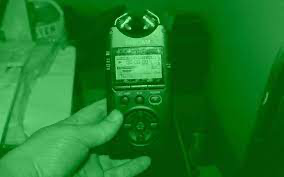
Many years back, we would record audio during our investigations, and then review it the next few days to make sense of things and discover what may have been a captured. These days, many ghost hunters will ask a few questions, then stand there and listen back to see what they may have been caught on a device. The theory being that depending on the responses they caught, their approaches and line of questioning to fit the responses already gained may change. This is a kind of reactive investigation technique, but in a response to an interpretation of potentially captured audio, I guess the risk being that if you have really connected to a spirit, then if you get it wrong, any communication may simply stop.
Another technique I’ve seen used is live listening, where ghost hunters are actively listening to the audio and call out any anomalies. This one I always found odd, as the ghost hunters do this whilst investigating and talking, so they could simply be contaminating their own audio. I’m honestly not sure if there really is any value in using this method, but many seem to use it. Although, when I’ve seen it used, it always seems if the ghost hunter that is live listening, introduces their own bias, by telling others what they’ve heard, so it’s obvious everyone listening will then hear the same.
It is this last point, that is a common trend in this area when it comes to ghost hunting. I’ve seen many explain to others what they have heard prior to asking them to listen to the audio; which immediately means they will often hear exactly that or similar. In very few occasions. have I seen a group of ghost hunters write down what they hear, and then compare it. Again this group confirmation devalues EVP within a ghost hunt in my opinion.
Of course, we must take into consideration that even the use of EVP within an investigation could be considered to show that the ghost hunters are already showing a belief in spirits. As they are using a digital recorder to record themselves, asking questions into the dark, to a supposed spirit. The very action advocates a belief that there is a spirit that may answer in first place. It’s something I have done myself in the past, but now looking back, I have to ask; did this mean that I thought that there was a spirit to talk to in the first place. In some cases I have investigated, there was certainly witness testimony that would have you believe such things. However, does that mean it’s the right approach is an investigation?
During this series, I will be questioning some of the ghost hunting approaches, advocating the need for change, or at least better clarification for using these techniques. Whilst EVP is a favourite of many ghost hunters, I am even a bit of a fan myself, it needs to be questioned.
Firstly, let’s discuss why we would record audio during an investigation. As many things, when we investigate the Paranormal, we would choose to record audio when audible phenomenon has been reported. This does not necessarily mean just the hearing of spooky voices. It basically refers to any noises that may be associated with the activity reported. Often this could be simply wraps or knocks that may have been heard. So, setting up a recording device in an area where the noise was heard, provides the opportunity to capture it, should it occur again. Then we can analyse it to understand what we may have heard. Often there is likely to be a logical explanation. So, as investigators, we often find ourselves more disappointed than calling out actual phenomena.
One thing that is often misinterpreted as being a ghostly voice is simply background noises. I was attending a public event once where a scary voice was caught during the question and response EVP session; saying ‘yes’ to a question. However, I quickly noticed that one individual was wearing a waterproof coat during the session, and they had trouble keeping still. In my opinion, it was the material of this coat, rubbing on itself that created the ‘yes’ sound. Well, many disagreed with me, but I persevered and re-created the recording. So, remaining mindful of your own surroundings is imperative when working with audio.
Another common mistake is relying on memory when reviewing audio, as more often than not the sequence and timing of events can be forgotten. This creates a scenario where spooky sounds on digital recorders are associated with spirits. When in reality they could be the living. In my opinion, many ghost hunters do not keep a good log of what occurred, and when, during an investigation. Which means actually proving events, is near on impossible, as there’s no reasonable timeline.
Conducting an EVP session during an investigation has become such a primary tool for ghost hunters that perhaps one thing that is not occurring is the question of what is really going on. As I mentioned earlier, the approach alone could present a belief in spirits and their ability to communicate. The reality could be that an individual, or even the group could be affecting the digital voice recorder. In fact, I have seen this before myself when I was present for a brief experiment conducted by Brian Cano; Something called the psychic projection experiment. Where the group thinks about a word they decide on, like ‘purple’ for about a minute. They focus that thought on the digital recorder as it records audio from their quiet room. If it works, the word appears in the audio somewhere, which should generally be only a minute or two in length. It is not a perfect Experiment, but it is certainly interesting. It is also helps to demonstrate the point that just because you capture a voice on a recording, that does not mean you have proof of a spirit being present. We have to ask; what else could be going on here?

EVP has become a major part of many ghost hunters approaches over the years. However, in some cases, it’s now used as a tool to provide more reactive drama than evidence. Is it an approach we should drop? Absolutely not, but perhaps focus on audio phenomena recording, rather than speaking to the dead. As often experiences include an audio element, so recording is needed. Primarily I use my own digital voice recorder to record witness testimony, and sometimes to capture odd noises. Once in a while, I may even try a little EVP session too, just for fun.
Is EVP reaching its last point of usefulness now, before it’s retired? What are your thoughts on EVP, it’s use and where we go next?

 Ashley Knibb
With the team I used to investigate with (sadly now disbanded), we were all required to have an audio recorder strapped to our left arm throughout the entire investigation. We would do a clap at the beginning of the investigation to coordinate audios (for later). And this way, if a potential EVP was captured, we could compare all the other audios to find out who was standing where in the room (sometimes with the help of video recordings as well), and if the sound captured was a rogue investigator whispering, if it was a natural sound, or a possible real EVP. There is a lot more to it than what I can get into here, but it seemed to be an effective technique for later reviewing and locating sounds that were recorded.
LikeLike
Thank you and interesting approach
LikeLiked by 1 person